Live simply and take life more easily. Happiness lies in giving yourself time to think and to introspect. Be alone once in a while, and remain more in silence. - Yogananda
Take some time to just sit today. Sit and be with yourself. Just sit.
I saw a news story today on signing up for WIRELESS AMBER ALERTS and wanted to share it with everyone. Please take a moment and pass it on to everyone you know. This is a FANTASTIC idea. Sign-up and you will receive Amber Alerts to your phone and email for the zip codes that you list. It is amazing how many children have been saved since Amber Alerts came into effect. Let's do all we can to help Law Enforcement find Missing and Exploited Children.
Sometimes in the evenings I like to flip the channels on the TV to relax. I can do this better then most men...flip...flip...flip.... I don't really watch a lot of TV, but I like to flip. There is something relaxing to me about getting these brief snap shots of what is going on in the world (or at least the world of TV.)
As I do my evening "flip flip" I FREQUENTLY see an infomercial for this fitness program called P90X. I'll be honest with you it doesn't look all that bad; it seems to combine a lot of different simple strength building exercises, plyometrics and cardio that should work very well if you do them consistently (that's always the key.) But, the part I LOVE...just LOVE...is that they have an yoga component that they call...wait for it...drum roll please...
EXTREME YOGA!
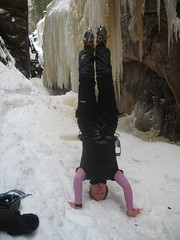
Wowzie! Really? Extreme yoga? I mean extreme running, extreme kayaking...I went ice climbing once, that was pretty extreme, but extreme yoga? It seems like a contradiction in terms to me. Yoga is all about "medhum," being moderate in all things; walking the Middle Path.
But, then I started to think about it and yoga really IS extreme.
And most of all it is an EXTREME experiment and exercise in the development of our Inner Selves. It is perhaps one of the most radical, most extreme journeys, a human being can undertake. To make a commitment to the exploration and development of oneself takes the heart of a warrior and the patience of a saint; and man-oh-man is it worth every moment of effort on the journey.
May your journey be wild, wonderful, enlightening...and what the heck, even a little extreme:-)
Kate S. from California! (who writes a really awesome and very funny blog herself)
Thanks for participating Kate! You won the awesome (if I do say so myself) handmade necklace (by me — see more of my stuff at www.tealdesigns.net) featuring amethyst (which symbolizes the Spirit), Indian crow beads, and Czech glass. The center pendant is a pewter Celtic cross.
Kate downloaded my Progressive Relaxation from yogadownload.com and I think she liked it because she left the following review...
"Teal Chimblo could read the phonebook to me, and I would relax. Having her gentle voice instruct me on the relaxation of each part of my body is a step beyond! I chose the version with the music, and I would recommend it. The music is lovely, soothing, and very much in the background. You almost don't realize it's there. I highly recommend this lovely meditation. I suffer from chronic anxiety, back pain, and TMJ. If I can relax with this, ANYONE can!"
Well, with a review like how can you resist heading on over to yogadownload.com to get your own copy.
For less than the cost of a cup of coffee ($2.95) you can give yourself a little bit of bliss today.
While your there check out my Sivasana Meditation as well. It's really yummy too!
AND...
This week TWO NEW offerings will be up on the site. One is a 20 minute yoga class where you learn 3 of the foundation breaths for yoga practice: 3-Part Complete Breath, Nadi Shodhana, and a Measured Breath.
The other is called Sleepy, Sleepy Moon and it is just the sweetest bedtime meditation and breathing exercise for children. It is guarrenteed to put your child and YOU to sleep.
This is such a great opportunity to give a little that will mean SO much to families who have lost so very much. We are receiving a lot of applications, please help us to help them.
The practice of lovingkindness (or Metta, in Pali) comes to us from the Buddhist tradition, but its essence is a tenant of all major religions. The instructions are simple and universal: love yourself, love each other; and yet, we struggle with its application. It is easy enough to love ourselves or someone else when they are doing things that we like, but the challenges can be great when we are confronted with those whose actions are seemingly “unlovable,” or when we are faced with aspects of ourselves that we find hard to accept with love and compassion. Thomas Merton expressed the challenge, and heroic nature of our struggle to embrace with lovingkindness that which we like least in ourselves, and others, when he said, “True prayer and love are learned in the hour when prayer becomes impossible and the heart has turned to stone.”
The idea behind the Buddhist approach to lovingkindness practice is that it is, a practice. Something we must do repeatedly and with discipline until it becomes an integral part of our deepest selves; an automatic reaction to people and events in our world. The process of turning a heart of stone into a heart that is softened with the deepest compassion and love is a step-by-step process that we have the opportunity to practice in every moment of our lives.
One of the most effective ways to begin a lovingkindness practice is through the use of Metta meditation. In this simple meditation we offer a wish for freedom, happiness, and the cessation of suffering for a particular person, group, or the entire world. A basic Metta meditation for all beings is:
May all beings be happy. May all beings be free from suffering. May all beings be at peace.
An example of Metta directed towards a particular person is: May _________ be happy. May _________ be free from harm. May _________ be filled with peace.
You can repeat one, or all three of the phrases over and over, aloud or in your head, for 2-5 minutes while visualizing the person or group you are focusing on, and imagining that you are sending this lovingkindness out to them. Because it can be challenging to focus on and offer this sort of energy to those who we have negative feelings towards, it is recommended that the practitioner proceed by first offering Metta to themselves, then to a benefactor, a friend, a neutral person (bank teller, someone you see on a walk), a difficult person, and finally, All Beings. It is important to start the focus of our practice by offering lovingkindness to ourselves, because only by having a truly deep and abiding love for ourselves can we have this same love for others.
As part of the self-love aspect of a lovingkindness practice we can reflect back to the yogic practice of Ahimsa (non-violence, non-harming.) We must remember as we strive to fill our hearts, minds and actions with lovingkindness that we are only human, and we will often fall short of our ideals. In those moments we must embrace Ahimsa and not react violently towards ourselves, but rather use the next moment as an opportunity to start once again in the mindset of lovingkindness by offering it with gentleness and compassion to our selves.
Because Metta meditation is formed from such simple phrases it is a wonderfully portable tool that we can bring into our daily application of lovingkindness. When we find ourselves in a long line at the supermarket, or being cut off in traffic, or treated unfairly in our workplace, instead of becoming angry, and slipping to what author Joseph Goldstein calls, “the seductive habit of finding fault,” we can pause for a moment and offer a pledge of lovingkindness to the person that is causing us distress. By slowing down and being less reactive, we can often see the good qualities of the person we are confronted with, or “put ourselves in their shoes” for a moment. From this calm, centered point-of-view we can better see the reality of the situation and act in a logical manner that will bring the most wholesome outcome for all those involved, rather then reacting from a place of fear, irritation and anger. In time, lovingkindness removes the illusion of separation from each other that we often feel.
As the Dalai Lama says, “Through the practice of lovingkindness and compassion I have found that all human beings are just like me.”
May you be happy. May you be free from all suffering. May you be filled with peace.
Lovingkindness Practice Resources Lovingkindness: The Revolutionary Art of Happiness by Sharon Salzberg Radical Acceptance: Embracing Your Life With the Heart of a Buddha by Tara Brach The Gift of Loving-Kindness: 100 Meditations on Compassion, Generosity, & Forgiveness by Mary Brantley and Tesilya Hanauer DailyBuddhism.com (Website) from Brian Schell
A pic from our wedding in November and a few thoughts on love.
Love has no other desire but to fulfill itself. But if you love and must needs have desires, let these be your desires: To melt and be like a running brook that sings its melody to the night. To know the pain of too much tenderness. To be wounded by your own understanding of love; And to bleed willingly and joyfully. To wake at dawn with a winged heart and give thanks for another day of loving; To rest at the noon hour and meditate love's ecstasy; To return home at eventide with gratitude; And then to sleep with a prayer for the beloved in your heart and a song of praise upon your lips.
Today Matt Logelin and his sweet little cutie pie, little girl Madeline were on the Rachel Ray Show (I felt super special because I was on there for about 10 seconds too!:-) If you don't know Matt's story it is a really tough one...
On March 24, 2008, little Madeline Elizabeth Logelin came into this world.
The next day, her mother left it.
From this impossibly tragic event, a community was born. A community of individuals, united in their desire to help and support Madeline and her father, Matt. This community formed the basis for what would become a worldwide charitable foundation:
What is so wonderful about the story is the out-pouring of support Matt has received. I've been privileged to play a small part by creating the foundation logo, but there is a group of amazing women out there (helloooo Creepies) that have done an ASTOUNDING amount of work to help Matt, and now the Liz Logelin Foundation.
But, the work has just begun.
The foundation is just getting started and really needs your help. To make this easier consider the $7 on the 7th program. "Skip the latte" for a couple days and do a little karma yoga (selfless service) by helping families in crisis.
(If you would like to add this widget to your blog, click here.)
If you'd like to help by donating your services to the foundation, making a contribution, adding the LLF widget to your blog, you can find out information on how to do this on the Liz Logelin Foundation homepage.
Check out these beautiful malas (prayer/meditation beads) from Mayhem Arts. They are having a really good sale on these beautiful handmade pieces. A good time to pick up a mala for your practice.
Win this beautiful amethyst and Czech glass necklace made by me!
This necklace was handmade by me and contains beautiful chunks of amethyst (which symbolizes the spirit), Indian crow beads, and Czech glass. The center pendant is a pewter Celtic cross. The necklace is 15.5 inches long and has a safety clasp. Jewelry making is a meditation for me and I infuse all the pieces I make with good energy and light for those who wear them.
How do I win?
FIRST
If you have already downloaded one of the classes - AWESOME- and thank you! Simply go to the yogadownload.com site and leave a review for either or both meditations. You will be entered once for each review you leave.
SECOND
If you haven't downloaded a meditation yet, do so and leave a review between now and March 6 and you will be entered to win!
DESCRIPTIONS AND LINKS TO DOWNLOADS
At only $2.95 per downloadable class (less then a cup of coffee!) you can give the gift of bliss to yourself, or a friend.
Two meditations are currently available:
Progressive Relaxation #1 will take you to a place of complete and utter serenity. "Teal's warm and meditative voice is ideal to help you get deep into a state of calm and tranquility. In this meditation Teal has you visualize a white light as it moves through you body and rids it of any and all stress and tension. Ahhhhhh!"
Sivasana Relaxation #1. Sivasana is a posture often practiced at the end of a yoga class, but you can do this relaxing Sivasana meditation any time you need to take a break and rest. Sivasana helps the body, mind and spirit to relax, integrate, and restore. This Sivasana Relaxation meditation will take you into a deep state of calm and is also great as a cure for insomnia.
I can not express my gratitude to all the people who downloaded my guided meditations over the last 3 months. It was wonderful to see such a positive response and it makes me happy to know they are helping to bring stress relief and relaxation into so many lives. There will be many more to come, so stay tuned...
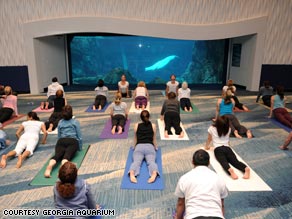
This story was sent to me by my awesome college roomate Joya Lonsdale. Is this not the most beautiful idea??? I can't imagine a more peaceful environment for a class...unless we could really be under the sea with them:-)
Utthita Trikonasana (extended triangle pose) is a foundational yoga posture that engages, stretches and strengthens the entire body.
There is a sacred geometry inherent in all yoga asana. Placing the body mindfully and with proper alignment into yoga asanas activates the energy meridians in the body thereby increasing the flow of Prana (vital life force) throughout our bodies.
In Trikonasana, as in all standing poses, the foundation is in the connection the feet make with the earth and the energetic activations of the muscles in the legs. It is an excellent posture to build strength in the legs, core and back. The intense lateral side stretch and opening of the chest also aid in developing deep breathing.
Often when students new to yoga (and old, for that matter) move into Trikonasana they mistakenly focus their attention on getting the hand down to the floor. This is TOTALLY unnecessary. The hand may never reach the floor, and it if reaches it only by shortening the side waist on the extended side, collapsing the chest forward, or over straining the legs (sometimes all three!) then the sacred architecture and the great benefits of the posture are lost. What is more, serious injury may occur. Keep the hand as high up on the leg as necessary to keep the integrity of the pose (never press on the knee), or use a block as an excellent prop to assist in the pose.
Enjoy making yourself into a glorious extended triangle! Jai Bhagwan!
HOW TO DO IT: This is very good clear instruction for Utthita Trikonasana (extended triangle pose), given by John Schumacher, a senior Iyengar Yoga teacher and director of Unity Woods Yoga, in Washington, D.C.
AND FOR FUN: This is just TOO cute and clever, and quite good instruction, except for the hyper-extended knee:-)
One of my favorite morning reads is my battered old copy of the Bhagavad Gita (The Song of God.) I purchased it in high school at Peace of Mind Bookstore, and my copy was old and used when I got it. Now it looks to be almost as old as the 3,000 year old Vedic scripture contained within; but the message is ever shiny and new, and as deeply relevant now as it was when it was first told. Whenever I read it my heart fills up with love, peace and a deep sense of purpose for my life.
The Gita is nestled within a larger poem The Mahabharata, the longest epic poem ever written, which tells many wonderful stories of "Great India" (another fascinating and illuminating read.)
In the Bhagavad Gita, the great warrior Arjuna is on the battlefield, faced with the horrible dilemma of impending war. He is soul sick about how he should proceed and calls on Lord Krishna for help. The poem is a conversation between Lord Krishna and Arjuna, and is a deep metaphor for the struggles facing all of humanity on the "battlefield" of Life.
There are many lines from this poem that come back to me again and again, but none more than these:
The Atman* is light: The light is covered by darkness: This darkness is delusion: That is why we dream.
* One's true Self.
This is the primary meditation for my own journey with yoga. To constantly return to where I truly am; to lay down the cloak of darkness that swallows me in delusion and makes me think that I am something other than a being of light in union with all things. I repeat the mantra to my self: Sat Nam. I am That, I am.
As you move through your day with yoga, or head to the mat for your sadhana, I encourage you to write these words from the Gita on a peace of paper and make them a part of your contemplation and meditation into your own true nature.
Thank you to Carolyn, and all the other lovely people who signed up for the Blissful Body Yoga Newsletter in January.
If you haven't signed up yet, today is a great day to do so! FIRST, because then you will be entered to win the February tote bag, and SECOND, because I am sending out a new newsletter tomorrow and it will be chock full of goodies, and details on yet another great giveaway (this one involves jewelry... people...I'm just saying! (sign up is easy, just fill out the form in the right hand column, and hit submit.)
Have a great day, and ::b r e a t h e:: deeeeeply.
In case you needed another reason to eliminate products containing high fructose corn syrup (HFCS) from your diet (and believe me if you haven't started doing this, you will want to after reading this article) here is one more: mercury. Not exactly something we want to be ingesting.
Mercury is a heavy metal and loves to store itself in the fatty cells of the body. The fattiest cells of all are in our brains, and this is not good news for this delicate organ. Remember the Mad Hatter in Alice in Wonderland? That was actually based on the fact that "hatters" used a glue in the binding of hats that contained mercury. Constant exposure to this substance actually caused brain damage and "madness," in some cases.
When you begin the crusade to eliminate HFCS from your diet, you are going to discover it is in everything; not just things you would expect like sodas. It is in salad dressings, mustards, crackers, etc. Check your labels...buyer beware!
There are lots of healthy alternatives out there for products you commonly use, and the more consumers demand with their dollars that this is what they want, the more manufacturers will eliminate this nasty stuff from their mixtures.
The yogi strives to eat a wholesome Satvic diet that nourishes the body. This is always best accomplished by eating a whole food diet. Basically, if it doesn't come out of the ground or off a tree, try to avoid it. Packaged foods, even the best quality ones, are always going to be less nutritious, have less Prana (vital energy) then a natural food.
Make small changes every day, and it won't be overwhelming, I promise! You will feel and look better, and be on your way to a longer and more blissful life.
Namaste.
The original article (shown below as well), along with a lot more information on HFCS and mercury can be found on the great web site GRIST: Environmental News and Commentary, here.
High-fructose corn syrup rose from obscurity to ubiquity starting in the late 1970s, borne up by an informal public-private partnership between grain-processing giant Archer Daniels Midland and the federal government. For me, HFCS is at best a highly processed, lavishly subsidized, calorie-heavy, nutritional vacuum.
I recently visited a public high school in Boone, N.C. The main hall literally hummed with machines peddling variations on Coca-Cola's formula for success: fizzy water with artificial flavor, artificial color, added caffeine, and a jolt of HFCS. Other machines displayed snack "foods" tarted up with HFCS. Why are we feeding our kids this crap, again?
Now comes news that makes even an HFCS cynic like me do a spit-take over my home-brewed morning coffee. Turns out that HFCS is commonly tainted with mercury -- a highly toxic substance -- according to a peer-reviewed report published by Environmental Health (abstract here; PDF of the must-read full text here.)
The Environmental Health study draws on samples of high-fructose corn syrup taken straight from the factory. But no one drinks the stuff straight. What about, say, cookies sweetened with HFCS? The Institute for Agriculture and Trade Policy plucked HFCS-containing products from supermarket shelves and tested them for mercury. The result?
Overall, we found detectable mercury in 17 of 55 samples, or around 31 percent
Traces of mercury turned up in name-brand products from makers including Quaker, Hunt's, Manwich, Hershey's, Smucker's, Kraft, Nutri-Grain, and Yoplait.
That a ubiquitous industrial-food ingredient such as HFCS should be tainted by mercury is bad enough. But it gets worse. The FDA has apparently known about this since 2005 -- and done nothing to publicize it or change it.
In 2005, EH study lead author Renee Dufault was an FDA researcher. At that time, she conducted the tests now cited in the EH report. Her results found mercury in 9 of 20 HFCS samples -- 45 percent.
She doesn't comment on why, but the FDA apparently did nothing with her results in the years since they emerged. She retired from the agency in March 2008 -- and evidently decided to go public. She deserves praise for the decision to publish her work -- essentially blowing the whistle on what looks like an egregious attempt to hide key information from the public.
So how does mercury work its way into our the food industry's favorite sweetener? It finds its way into Pop Tarts and the like through the stunning array chemicals required to transform corn into a cane sugar substitute. (As you read the following list, marvel that the FDA recently ruled that manufacturers can label HFCS-sweetened foods "natural.") According the the EH study:
Several chemicals are required to make HFCS, including caustic soda, hydrochloric acid, alpha-amylase, gluco-amylase, isomerase, ilter aid, powdered carbon, calcium chloride, and magnesium sulfate.
Two of those charming-sounding chemicals -- caustic soda and hydrochloric acid -- can contain traces of mercury.
Caustic soda and hydrochloric acid are made through the same processes that produce chlorine. It can be done in one of two ways. The first involves pumping saltwater through a vat of mercury. The stuff produced this way is known as "mercury grade."
The second process involves no mercury. The industry is shifting to the second process, but the mercury style has by no means been phased out. According to IATP, "Today, the chlorine industry remains the largest intentional consumer (end user) of mercury."
So you've got this "mercury grade" caustic soda and hydrochloric acid floating around. Guess who's using it? According to the EH study, "mercury grade caustic soda and hydrochloric acid are primarily used by the high fructose corn syrup industry."
Not only did the FDA fail to inform the public of HFCS's mercury problem; food manufacturers that use HFCS may have been in the dark, IATP reports.
There is one hopeful tidbit from the highly disturbing Environmental Health and Institute for Agriculture and Trade Policy studies. Several years ago, then-Sen. Barack Obama introduced legislation that would have forced the chlorine industry to phase out mercury.
That bill failed. I hope the new Congress revives it. And I hope the Obama FDA investigates precisely why the agency sat on information that could have saved consumers from mercury exposure. The officials who made that decision -- as well as the HFCS industry, led by Archer Daniels Midland -- must be held to account.
Yesterday was certainly a day full of immense energy here in the United States, and around the world, as we witnessed the inauguration of President Barack Hussein Obama. The swearing into office of this president was particularly significant for many reasons, but I think the thing that struck me most about the ceremony, is the same thing that amazes me each time we have a new president: the peaceful transfer of so much power. We need only look around the world today, or in the annals of human history, to see what a rare, and impressive occurrence this is. It makes me very proud of my country.
As I watched the inauguration yesterday it was wonderful to see so many happy, hopeful people. As a yogini I know that there is nothing more powerful, more initiating of great change, then the power of unity, optimism and positive thinking. I feel this country has suffered a great, "dark night of the soul" in recent years, and I too, feel that yesterday was the dawn of a new day, in many ways.
However, I also felt a great level of concern about the unrealistic, and somewhat excessive nature of the enthusiasm. Without getting into what I personally perceive Barack Obama's strengths and weakness as the leader of our country may be, I am absolutely certain that he is a man, not a messiah. And man, does he have his work cut out for him.
Listening to the almost frenzied way that some people have been talking about him over the last year, I've really come to feel a bit sorry for the guy. People have put him up, I think unfairly, on a very high pedestal, and it is a very long fall from there.
I am also concerned by the ferocious hatred I see coming from both "sides" of the political spectrum. I feel it in myself. I have opinions, strong ones, and sometimes it is hard for me to accept that others are entitled to theirs. I can feel the tightness and separation this causes in myself, and I see it in other people. We must work with great vigor to recognize that this separation is illusion. We must, as the Dalai Lama says, "find through compassion that all human beings are just like me." This is the tallest order of all, but I believe it is a worthy goal that we must strive towards.
How can yoga inform a situation like this?
Yoga is at it's core a set of teachings focusing on union, and on staying firmly rooted in "the middle path," where we are not subject to the highs and lows of excess in any area, including emotions. As the Bhagavad Gita teaches us, "A lamp does not flicker in a place with no wind." Powerful emotions can set us on fire with enthusiasm and energy, but they may not sustain us over a long haul when the initial "glow" of an exciting situation has worn off.
I say all this not to rain on any one's parade, not to diminish the excitement and power of this time, but to offer a call for a level of rationalism and realism, that will help us as a country, and throughout the world, to sustain a positive momentum for all the hard and long work we, and our new president, have ahead of us.
On this day I have a wish and prayer, from the bottom of my heart, for this man, for my country, and for this planet.
It is a portion of the Saha Navavatu Mantra that we often recite at the beginning of a yoga class, and it helps to define the scope and the nature of the work before us. I think it beautifully expresses the energy of enthusiasm, realism, and unity, we must have on our journey of "the middle path."
OM saha navavatu saha nau bhunaktu saha viryam karavavahai tejasvi navadhitamastu ma vidvishavahai OM shanti, shanti, shanti
Om May we be protected together May we be nourished together May we work together with great vigor May our study be enlightening May no obstacle arise between us Om peace, peace, peace
As one year comes to a close, and we begin to contemplate the next, a lot of us make these interesting lists called, New Year's Resolutions. They are usually brimming with hope and optimism, and chock full of things we want to “fix” about our selves, and our lives. So, how does the modern yogi or yogini go about creating a New Year’s Resolution list; and what does the ancient science of Yoga have to offer us as we consider the changes we want to make?
Yoga says,
“ You are already whole, already perfect. There is nothing to do, nothing to fix.”
Wow. Do you feel a tremendous load off your shoulders? You are done! Hooray! There was never really anything you needed to do. You are already perfect, beautiful, radiant and whole, and you always have been.
Yoga teaches us that our feelings of inadequacy stem from the illusion of separation. We often experience this “duality” or sense of separation as feelings of isolation, loneliness, and fear. We may constantly criticize our bodies, actions, and thoughts. Yoga teaches that there is no need to do this, and that these himsic, or harming, thought patterns, are toxic and keep us from enjoying the full experience of our lives.
Yoga also teaches us to practice santosha, or contentment by letting go of our grasping to the negative stories we tell ourselves, and cultivating right thinking and equanimity. This does not mean that we do not experience all the ups and downs of life, but that we are able to view them with perspective and balance.
However, there is a paradox in the idea of Contentment. If we were all completely content all of the time, we would never do anything. A feeling of discontent is what motivates all of our thoughts and actions; from getting up to get something to eat because we are “discontent” with hunger, to making a major life change because we feel a deep dissatisfaction with something in our lives.
This brings us back to the idea of making a “self-improvement list” for ourselves in the New Year. There is nothing wrong with wanting to change or “improve” something about our selves; tremendous good can come from making changes to our lives. The problem comes when we use the opportunity for constructive change, as another means for destructive self-abuse. The first and foremost aim of any yogini should be to practice, ahimsa, or non-harming, toward herself and all other sentient beings. So, as we make our lists we need to check our approach constantly against this benchmark, to insure that we are being kind and loving to ourselves, and others, in the process.
Let’s take a very common New Year’s resolution as an example: the desire to loose weight.
A common scenario is that we begin in January filled with a fire to loose weight and get in shape. We are joined in yoga studios, gyms and walking paths by others trying to “whip themselves into shape.” By the end of January those places are far less full, and we are home feeling increasingly dejected, eating more, exercising less, and feeling pretty bad about our selves.
The Yogic perspective on loosing weight would say, “Anything can be done in time, and with kindness.”
Making changes takes time, and it takes a plan; add in the component of kindness and you are bound for success. Without kindness, self-doubt and self-criticism beginning to chip away at our “resolve”, and make us feel like the task in insurmountable.
Let’s take a look at what a Yogic New Year’s Resolutions for Loosing Weight List might look like:
I (your name here) love my body and support and nourish myself with healthy food and exercise.
I give myself this love and support to increase my physical strength, cardiovascular health, and mental health.
I show my commitment to loving and nurturing my physical and emotional growth by attending a yoga class 3 times a week for 60 minutes, and walking in my neighborhood, 3 times a week for 30 minutes.
I have a positive relationship with food, and I choose foods that will give my body the optimum nutrients and calories I need to thrive in radiant health.
I am living in a healthy body, at a weight that is beneficial for all my physical systems. My body is energetic and strong and contains all the vitality I need to live my fully realized life.
As you can see this kind of list combines concrete actions with positive affirmations. This enables you to formulate a realistic course of action for self-improvement that harnesses the power of creative visualization, and reinforces the focus on self-love and the practice of ahimsa (non-harming) toward yourself and others.
Keep your list short, affirmative and in the present tense, as if you are already living the life (in this case living in the body) that you desire to have. Remember, once you think and believe these things, they already exist, all the remains is for you to manifest them into your life in a physical way. If you cannot imagine yourself in the body, or leading the life you want to lead, it will be difficult for you to realize those things fully in your life. See it, then be it!
Another helpful concept brought to us by the science of Yoga, is the focus on action, rather then outcome. The great yogic scripture, the Bhagavad Gita states, “Have no attachment to the ownership or result...” instead the focus must always be on each individual action.
We can apply this to our weight loss example by releasing our concerns about how much weight, or how many inches we will loose, and instead focus on each thing we are doing moment to moment to reach that goal. For example: focusing on the quality and attention we bring to each yoga posture, in each class; or by placing our attention on the energy we put into cooking each healthy meal, and eating it slowly with loving care for each bite.
This focus on one thing at a time, keeps us deeply grounded in the present moment, which in reality is the only thing we can influence, and the only thing that really exists. We may start with a certain goal, and find that it ends in a completely different outcome due to circumstance beyond our control. However, if we have cultivated mindfulness and focused on actions, instead of outcomes, then it is easier for us to release that result, and know that we have done our best, and that is all that we can do.
So, as you continue working on your list of resolutions for the coming year remember to keep them positive, be kind to yourself, focus on action instead of outcome, and remember that you are already perfect, beautiful, radiant and whole, and you always have been.
Image by kristin pfannkuchen via FlickrJust a few quotes to inspire your practice of Yoga, on, and off, the mat this weekend...
Blessed are the flexible, for they shall not be bent out of shape. ~Author Unknown
Yoga is bodily gospel. ~Reaven Fields
Yoga, an ancient but perfect science, deals with the evolution of humanity. This evolution includes all aspects of one's being, from bodily health to self-realization. Yoga means union - the union of body with consciousness and consciousness with the soul. Yoga cultivates the ways of maintaining a balanced attitude in day-to-day life and endows skill in the performance of one's actions. ~B.K.S. Iyengar, Astadala Yogamala
Inhale, and God approaches you. Hold the inhalation, and God remains with you. Exhale, and you approach God. Hold the exhalation, and surrender to God. ~Krishnamacharya
Yoga is 99% practice and 1% knowledge. ~Sri Krishna Pattabhi Jois
Fear less, hope more; eat less, chew more; whine less, breathe more; talk less, say more; hate less, love more; and all good things are yours. ~Swedish Proverb
Image by wallyg via FlickrLooking for some new tunes to enhance your yoga practice? I just found Yoga Radio this morning and it is a cool way to hear some new music. Check it out:
My students are always asking, "what was that song?" So, I thought this would be a nice way to share some of the play lists I create for my yoga classes, and just mixes of music that I enjoy. Hope you will enjoy it too, and that it infuses your practice with energy and ananda (bliss).

 Image by Claudio.Ar via Flickr